Normal thyroid labs do not rule out a thyroid problem. A standard screen usually checks TSH and sometimes T4 — but it never measures Free T3 or Reverse T3, the hormones that decide whether your cells actually get fuel. That is why so many people are told their thyroid is fine while every symptom on this page keeps getting worse.
What Symptoms Show Up When Your Labs Are "Normal"?
Does any of this sound familiar to you?
- You’re constantly tired
- You struggle with weight gain
- You’re always feeling cold or sensitive to the cold
- You’re constipated and/or have less than 1 bowel movement per day
- Your skin is dry
- Your hair is falling out or is just brittle
- You have muscle weakness/aches
- You’re depressed
- Your memory is not great
- Your voice is hoarse
- Your face and/or your extremities are puffy
- And finally……Your Doctor says your thyroid numbers look fine. Your thyroid is fine.
You’re not fine (and you know it).
That list is not random. Every item on it is a downstream effect of low thyroid action at the cell level — slow metabolism in muscle, skin, gut, and brain. When patients describe all of these at once, the pattern is so consistent that we treat it as a thyroid signal regardless of what one screening marker says.
Most of these patients have been through the same loop. The fatigue gets blamed on sleep, the weight on diet, the mood on stress. Each symptom gets its own appointment and its own prescription. Nobody looks at the one system that produces all of them at the same time.
There is a name for this exact situation: thyroid symptoms with normal labs. It is one of the most common reasons people end up in our office in Wilmington, and it is solvable once the right markers get measured.
Why Do Normal Thyroid Labs Not Rule Out a Thyroid Problem?
Well guess what? - There is an answer for this and it’s likely in the form of something called Reverse T3
Ever heard of it? Most people haven’t. Read on….
First, the lab side of the story. A standard thyroid screen is built to catch overt hypothyroidism — a gland that has clearly failed. It is not built to catch a conversion problem, an immune attack, or a binding hormone problem. So the screen comes back "normal" while three or four other mechanisms are quietly working against you.
| TSH-only screen | Complete thyroid panel | |
|---|---|---|
| Markers measured | TSH, sometimes Total T4 | TSH, Free T4, Free T3, Reverse T3, TPO antibodies, thyroglobulin antibodies |
| What it can detect | An overtly underactive or overactive gland | Production, conversion, blocking, and immune attack |
| What it misses | Hashimoto's in early stages, poor T4-to-T3 conversion, high Reverse T3, fluctuating thyroid output | Very little of the standard thyroid picture |
| Result for a symptomatic patient | "Your thyroid is fine" — no explanation | A specific mechanism you can act on |
| Typical next step | Antidepressants, diet advice, "wait and see" | A targeted plan: nutrition, gut work, medication decisions with real data |
This is why we run a complete thyroid panel on anyone with the symptom picture above. The extra markers cost little and change the entire conversation — from "your labs are normal" to "here is the mechanism." We wrote more about this pattern in why you can have thyroid symptoms with normal labs.
One more thing about the word "normal." A lab reference range is a statistical spread of results from whoever happened to be tested — not a definition of healthy function. Your thyroid can be failing slowly while still sitting inside that spread. A doctor reads the range; your body tells you where in the range you are actually functioning. Both pieces of information matter, and only one of them is printed on the lab report.
What Is Reverse T3?
Reverse T3 (rT3) is an inactive thyroid hormone that acts as a "brake" on metabolism, often elevated in Hashimoto's when stress, infection, inflammation, or T4-only medication (such as levothyroxine or synthroid) prevents proper conversion of T4 into active T3.
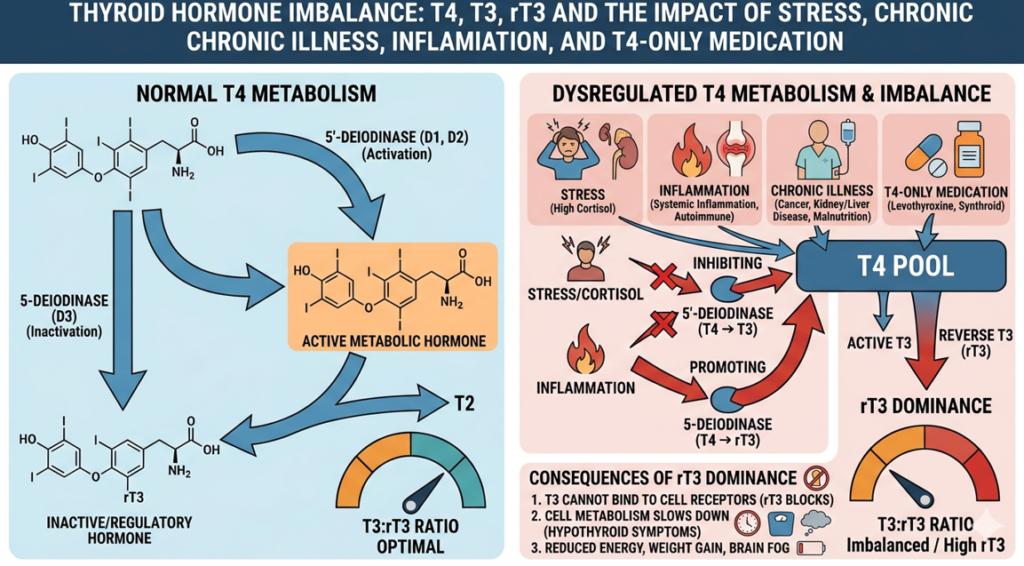
Reverse T3 is not a lab artifact or a curiosity marker. It is a real hormone your body makes on purpose during crisis — illness, injury, starvation — to slow everything down and conserve resources. The problem is not that the brake exists. The problem is a brake that never releases.
What pushes T4 down this pathway is worth knowing, because almost all of it is testable:
- Chronic stress and a disrupted cortisol rhythm
- Illness, recent infection, or an unresolved viral burden
- Crash dieting, long calorie restriction, or overtraining
- Inflammation from the gut, food reactions, or the autoimmune attack itself
- T4-only medication (levothyroxine, synthroid) when conversion is impaired
- Low iron, selenium, or zinc — the raw materials conversion requires
Notice that every item on that list is a physical state, not a personality trait. "Stress" here means measurable cortisol patterns. "Inflammation" means cytokines and gut markers. These are things a lab can find and a plan can change.
How Does Your Body Choose Between T3 and Reverse T3?
When you are diagnosed with Hashimoto’s, your Doctor likely just focuses on your TSH (Thyroid Stimulating Hormone) and your T4 (the storage hormone). However, your body’s ability to use that hormone depends on a delicate conversion process. Under normal conditions, your body converts T4 into Free T3, which is the active "gasoline" that fuels your cells, heart, and brain.
But your body has an alternative pathway: it can convert T4 into Reverse T3. You can think of it as a "metabolic brake." While it looks nearly identical to active T3, it is biologically inactive. Its primary job is to slow you down to conserve energy. In a healthy system, this is a useful survival mechanism during periods of starvation or acute injury, but in your experience with Hashimoto’s, this brake can become stuck in the "on" position.
The same thing happens to patients on T4-only medication who never feel right on it. Levothyroxine and synthroid supply T4 — the raw material — but your body still has to choose which pathway to send it down. If the brake is stuck, more T4 simply becomes more Reverse T3. That is one reason dose increases sometimes make people feel worse instead of better.
A stuck brake produces the same symptom picture as a failing gland: fatigue that sleep never fixes, brain fog, weight that will not move despite eating less, cold hands and feet, constipation, hair loss, flat mood. The overlap is not a coincidence — it is the same cellular shortfall, reached by a different route.
Why Do Stress, Dieting, and Illness Put Your Metabolism on Ice?
The brake pathway exists for a good reason. In a true emergency — famine, severe injury, serious infection — slowing metabolism keeps you alive. Your body does not care about your weight or your workday in that moment; it is conserving fuel for survival.
Modern life triggers the same machinery without the emergency. Chronic stress, under-eating, repeated dieting, poor sleep, lingering infections, and blood sugar swings all read to your body as ongoing crisis. So the brake goes on — and stays on while you keep wondering why you feel hypothyroid with "normal" labs.
This is also why the details of your history matter so much. A patient who felt fine until a viral illness, a period of extreme dieting, or a stretch of heavy stress has told you when the brake engaged. That timeline points directly at which testing to run first.
And here is the part that surprises people: you do not have to choose between treating the thyroid and treating the trigger. The two go together. Thyroid hormone replacement corrects the shortfall in the tank, while addressing the brake — the stress pattern, the infection, the inflammation — is what lets your body actually use what is in it. Patients who do both consistently do better than patients who do either alone.
Why Do Hashimoto's and Inflammation Put the Brake On?
The relationship between Hashimoto’s and Reverse T3 is primarily driven by inflammation. Because Hashimoto’s is an autoimmune condition, your immune system is in a state of chronic activation, releasing inflammatory markers called cytokines. These cytokines interfere with the enzymes (deiodinases) responsible for thyroid conversion. Specifically, inflammation inhibits the enzyme that creates active T3 and stimulates the enzyme that creates Reverse T3.
This means that even if your thyroid is producing enough T4 (which means your TSH levels and T4 levels on bloodwork will look normal), or if you are taking a T4 medication like Levothyroxine, your body may be redirecting that hormone into the "brake" pathway. You might find yourself in a frustrating loop where your lab tests look "perfect" to a standard doctor, yet you feel profoundly hypothyroid because your receptors are being blocked.
By measuring your Reverse T3 alongside your Free T3, you can determine your Free T3/rT3 ratio, which provides a much clearer picture of whether your "metabolic engine" is actually getting the fuel it needs to run.
And if I were a betting a man, I’d bet the house that your Doctor has never even run that Reverse T3 marker to test your thyroid function.
Inflammation is not the only brake trigger, but it is the biggest one in Hashimoto's. Chronic stress, active infections, gut inflammation, and blood sugar swings all push T4 down the Reverse T3 pathway as well. This is why two people on the same thyroid dose can feel completely different — the difference is not the pill, it is what their body is doing with it.
Your symptoms have a mechanism behind them. One free call will tell you which missing markers could explain yours.
Book Free Discovery CallWhat Testing Reveals What Standard Labs Miss?
See, to reclaim your thyroid gland and your overall health, understanding all of these mechanisms and getting tested to see which of them are involved with your Hashimoto’s hypothyroidism, are critical.
- This requires comprehensive testing which your insurance doesn’t want to pay for.
- This requires an understanding of the testing and how to address these imbalances from a natural, diet & lifestyle perspective
- And finally, and this is important, this requires working with a Doctor who is not interested in masking the problem with a drug (levothyroxine, synthroid, armour thyroid, NP thyroid) because that’s what the insurance company says or what they’ll pay for.
Then for years, you might be on this medication that is “masking” the problem but not addressing the real cause(s).
Reverse T3 is one marker, not the whole evaluation. If the brake is stuck, the next question is what is holding it down. In practice that means checking the rest of the system: adrenal and hormone testing for cortisol and estrogen patterns that block conversion, gut and food sensitivity testing for the inflammation driving it, and nutrient markers like ferritin, selenium, and vitamin D that conversion depends on.
Sequence matters here too. Markers first, then the drivers behind them. When the Free T3/Reverse T3 picture is read next to cortisol rhythm, antibodies, and nutrient levels, the plan stops being a guessing game — you address the specific mechanism that is holding your brake down, and you have a baseline to measure progress against.
If you are already on thyroid medication and still feel like this, that is expected — not proof that nothing can be done. Our thyroid medication guide covers how replacement fits into a bigger plan, and why it works so much better once the underlying drivers of Hashimoto's disease are addressed.
What Should You Do Next?
And that’s where I come in.
I offer a free, 15-30 minute phone call consultation (a Discovery Call) to determine if you're a good fit for my office and to have any of your questions answered. From there we can discuss what tests you need (that your Doctor has ignored) and get some answers. Click here to take advantage of this offer - schedule that free call and start your journey to finally fixing your issue.
On that call we talk through your symptom timeline, what has already been tested, and what has never been looked at. You leave with a straight answer about which markers would explain your picture and whether our approach fits what you are dealing with. No pressure, no obligation.
Don't suffer with thyroid problems / Hashimoto’s any longer. Let's find out what’s causing your hypothyroidism, and stop masking the problem - let's finally solve it!
Feeling terrible is data. Book the free discovery call and let's find the lab your doctor never ran.
Book Free Discovery CallFrequently Asked Questions
Why are my thyroid labs normal but I feel terrible?
Standard screening usually checks TSH alone. TSH can look normal while Free T3 is low, Reverse T3 is high, or antibodies are attacking the gland. The symptoms are real — the standard test just isn't measuring what's wrong.
What thyroid tests should I ask for?
Ask for TSH, Free T4, Free T3, Reverse T3, and TPO and thyroglobulin antibodies. That complete panel shows how the hormone is being produced, converted and blocked — not just the signal from the pituitary.
Can stress cause normal labs but real symptoms?
Yes. Chronic stress raises cortisol, which can block T4-to-T3 conversion and push Reverse T3 up. TSH stays normal while you feel exhausted. Adrenal testing alongside the thyroid panel reveals the pattern.
What should I do if my doctor won't run more tests?
You can start with a free 15-minute discovery call with a practice that runs complete thyroid and root-cause testing. Bring your existing lab results — they're still useful — and we'll talk through what's missing.